
Local SEO for Columbus, Ohio Small Businesses | Grid49
Columbus isn't a small-town market. It's home to Ohio State University, one of the largest universities in the country, and to Fortune 500 companies like Nationwide, American Electric Power, and Abercrombie & Fitch. Columbus has been ranked among the top five U.S. cities for entrepreneurs, and its metro economy runs $130+ billion — the second-largest in Ohio. That combination of big business, a massive university population, and a genuinely strong startup and small-business scene makes Columbus one of the most competitive markets in the state to be found online.
That's the challenge. Here's the opportunity: competitive doesn't mean closed. It means you need a real strategy, and you need to actually stick with it — most of your competition won't. Big businesses have marketing budgets, but they're rarely optimizing for the specific, local searches that bring an actual customer through your door. That gap is exactly where a small business with the right local SEO strategy wins.
To show you what I mean, I pulled real search data for a handful of small-business industries in Columbus. Some are genuinely tough to break into. Others have real, immediate opportunity if you know where to look:
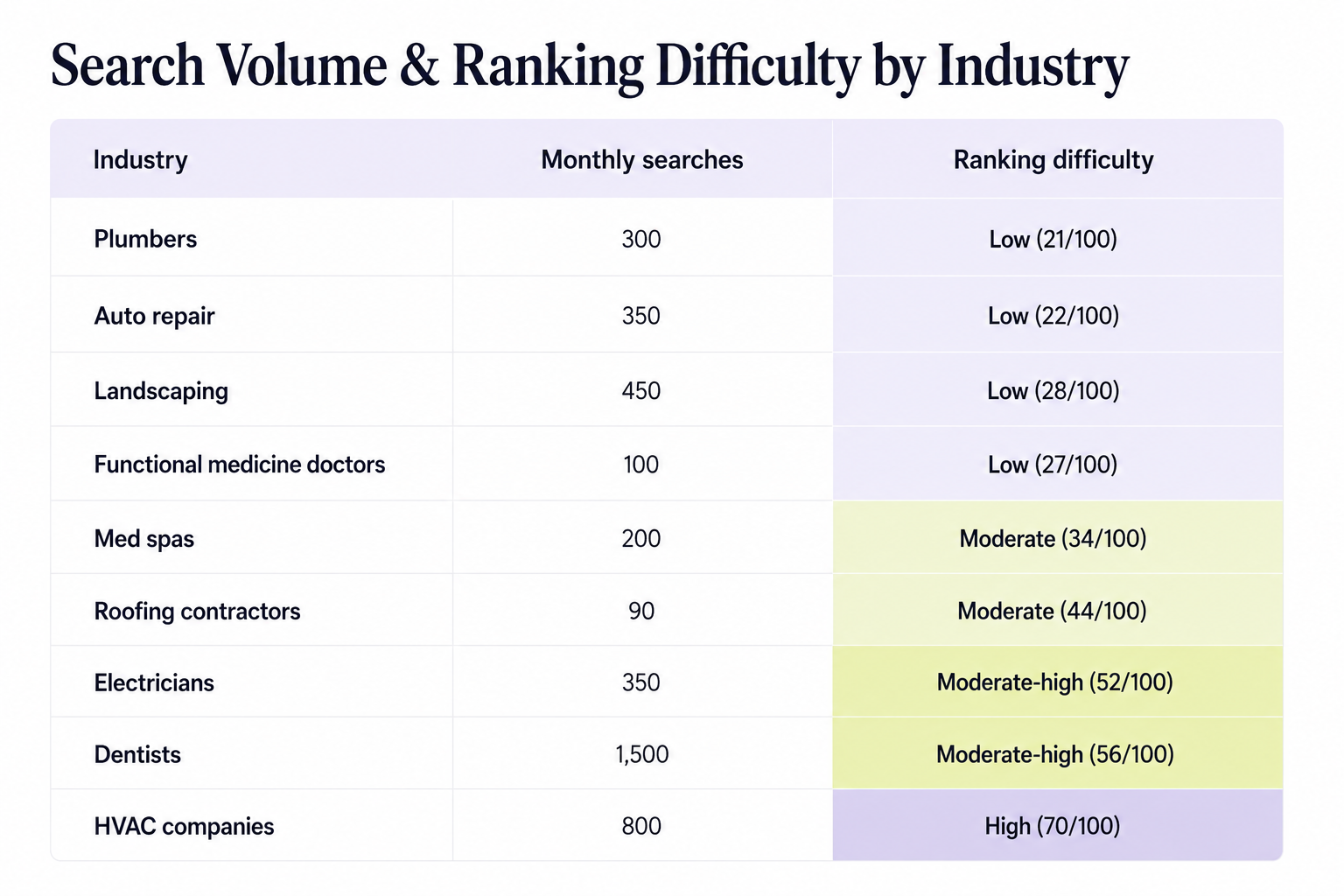
Notice the range. Plumbers, auto repair shops, landscapers, and functional medicine practices all have real search demand in Columbus with genuinely low competition — meaning a focused local SEO strategy could realistically get you ranking. HVAC and dentistry, on the other hand, are dominated by established players with years of authority behind them — not impossible, but it takes a more sustained, patient strategy to break in.
What Ranking Top Five Could Actually Be Worth
Quick note before the numbers: these are built from general industry averages, assuming a conservative 2–5% of monthly searches convert to new customers if you rank top five on Google Maps. Treat it as a starting point, not a guarantee — dentists and HVAC use lifetime/install value instead of a single visit, so those two rows naturally run bigger (noted below). Want your real numbers? That's what a consultation is for.
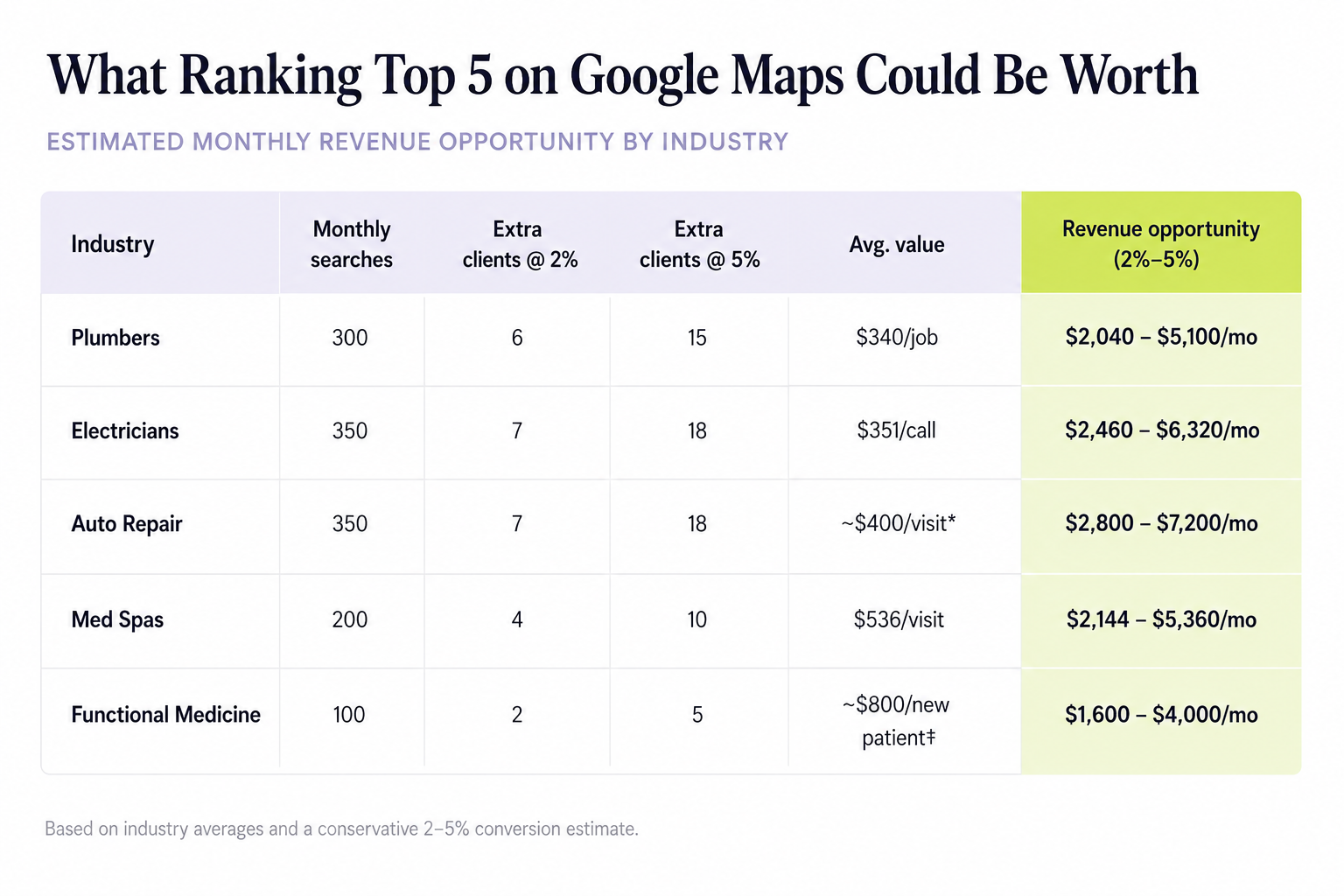
*Estimated figure, varies by job type. †Per contract, not monthly. ‡Lifetime patient value, not immediate cash.
Book a consultation for an estimate based on your current rankings and offers →
Three Places to Focus Your Columbus Local SEO Effort
Once you know which keywords are actually winnable for your business, the work breaks down into three buckets. You don't need to do all three perfectly at once — but neglecting one entirely usually caps how far the other two can take you.
1. Google Business Profile Optimization
Your Google Business Profile is often the very first impression a Columbus customer gets of your business, and it's free to fully optimize.
Claim and verify your profile if you haven't already — an unverified listing won't show up reliably in Maps results.
Fill out every field completely: primary category, relevant secondary categories, your actual service area (not just your city), hours, and attributes.
Write your business description with real, natural mentions of Columbus and the specific neighborhoods or suburbs you serve — not keyword-stuffed, just accurate.
Upload real photos regularly: your team, completed work, your location. Profiles with recent, real photos consistently outperform ones that go stale.
Post updates weekly through Google Posts — a recent job, a seasonal tip, a promotion.
List out your specific services with clear names and descriptions, not just a generic category.
Ask every satisfied customer for a review, and respond to all of them — good and bad — mentioning the service and area naturally in your reply.
Keep your name, address, and phone number (NAP) identical across your website and your profile — inconsistency quietly erodes your local ranking.
2. On-Site Content
This is where you prove to Google, and to actual customers, that you're a real local business worth ranking.
Build a dedicated Columbus location page with genuinely unique content — not a template with the city name swapped in. Include a local testimonial if you have one, your service area, and LocalBusiness schema markup.
Build individual service pages for each core offering, written for the specific problem that service solves, not just a list of features.
Publish blog content consistently — exactly like this post — targeting the specific, winnable long-tail keywords in your industry rather than competing for broad, saturated terms.
Create at least one or two authority pieces — in-depth guides that establish you as a genuine expert, not just another local listing.
Link your blog posts, service pages, and location page to each other. Internal linking helps Google understand how your site fits together, and it keeps visitors on your site longer.
Don't neglect the basics: clear title tags and meta descriptions, a logical heading structure, and a site that loads fast on mobile — most local searches happen on a phone.
3. Backlink Building
Backlinks are still one of the strongest trust signals you can build, and locally, they're often easier to earn than people assume.
Get listed in real local citation sources: the Columbus Chamber of Commerce, the Better Business Bureau, and industry-specific directories relevant to your field.
Sponsor or partner with something genuinely local — a youth sports team, a community event, a local nonprofit — most will link back to sponsors from their website.
Look for guest post or feature opportunities on Columbus-focused business or news outlets covering your industry.
Build real relationships with complementary (not competing) local businesses for natural, mutual links — a landscaper and a fencing company, for example, referring and linking to each other.
Watch for "best of Columbus" roundup posts in your industry and reach out to be included — these are often genuinely open to submissions and carry real local relevance.
Bringing It All Together
Three buckets, three tiers of how much of this you take on yourself. You could try to handle Google Business Profile, on-site content, and backlink building on top of actually running your business — and if you've got the extra hours, that's genuinely possible for the first bucket. It gets a lot harder to sustain once you're juggling all three, alongside everything else Columbus's competitive market demands of you.
A more realistic path for most small business owners is bringing in help gradually — start with a real strategy and grow the support as your business grows, whether that means a strategist mapping out the plan while you or your team execute, or eventually handing the whole thing off so you can focus on what you do best.
If you want a strategy built specifically for your business — not industry averages — that's exactly what a consultation is for. And if you already know you want the roadmap without the full hand-off, Co-Pilot gives you a complete monthly strategy and report while you or your team handle execution.